Great Educationists of India from History Who Shaped Our Learning
Honoring India’s legendary teachers — from ancient scholars to modern visionaries — whose wisdom continues to shape our learning on Teacher’s Day 2025.
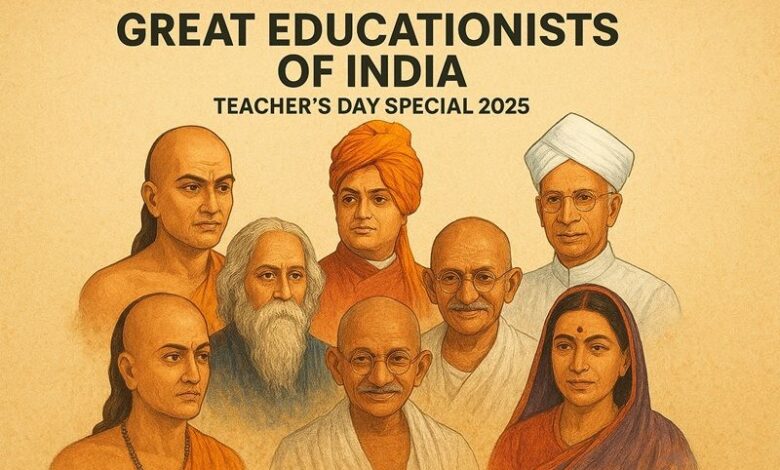
Every year, on September 5th, India celebrates Teacher’s Day with love and gratitude. The date is special because it marks the birth anniversary of Dr. Sarvepalli Radhakrishnan, a philosopher, scholar, and India’s second President, who believed that “teachers should be the best minds in the country.”
Teacher’s Day is not just a celebration with flowers, speeches, and thank-you notes. It is also a day to reflect on the long tradition of great educationists in India who shaped our learning and influenced the world. From the quiet Gurukuls of ancient times to modern classrooms, Indian teachers have been torchbearers of wisdom, values, and innovation.
Let us walk through history and remember some of the greatest educationists of India—men and women whose thoughts, courage, and vision continue to inspire us even today.
Ancient Indian Educationists
1. Chanakya (Kautilya) – The Teacher of Governance
Around 2,300 years ago, in the university town of Takshashila, a brilliant teacher was shaping the destiny of India. His name was Chanakya, also known as Kautilya. He was not just a teacher of politics and economics—he was a nation-builder.
Chanakya mentored Chandragupta Maurya, who went on to establish the great Maurya Empire. His book, the Arthashastra, laid down detailed lessons on governance, administration, finance, and diplomacy. Even today, business schools and leaders quote Chanakya’s strategies for problem-solving and leadership.
He showed us that a true teacher does not only give knowledge but also prepares students to change the world.
2. Panini – The Father of Grammar
Have you ever wondered how languages are structured? How do we form sentences? The credit for answering these questions goes to Panini, who lived in the 4th century BCE.

Panini created the Ashtadhyayi, a masterpiece of Sanskrit grammar, which is considered the most scientific grammar system in the world. Modern linguists still marvel at his brilliance. His work was so advanced that it laid the foundation for computer programming languages thousands of years later.
Panini proved that education is not limited by time—it can influence generations far beyond one’s life.
3. Aryabhata – The Genius of Mathematics and Astronomy
When we learn about zero, trigonometry, or the rotation of the Earth, we are actually learning lessons from Aryabhata, India’s legendary mathematician and astronomer.
Aryabhata, who lived in the 5th century CE, wrote the Aryabhatiya. In it, he explained that the Earth rotates on its axis, calculated eclipses, and introduced mathematical concepts that shaped modern science.
Aryabhata was not just solving equations—he was opening the universe for exploration. He showed that teachers can inspire humanity to look up at the stars and think beyond the ordinary.
Medieval Indian Educationists
4. Swami Vivekananda – Awakening the Youth
When Swami Vivekananda addressed the World Parliament of Religions in Chicago in 1893, the world saw not just a monk, but a teacher who spoke of character, courage, and self-confidence.
Vivekananda believed that “education is the manifestation of the perfection already in man.” For him, education was not about memorizing books, but about building strength, values, and character.
Through the Ramakrishna Mission, he spread the message of holistic education—balancing physical, mental, and spiritual development. His words still guide young Indians: “Arise, awake, and stop not till the goal is reached.”
5. Rabindranath Tagore – The Poet of Education
Rabindranath Tagore, India’s first Nobel laureate, believed education should be as free and beautiful as nature itself.
He founded Visva-Bharati University at Shantiniketan, where children studied under the open sky, surrounded by art, music, and creativity. Tagore rejected the idea of rigid classrooms and wanted students to learn by experience, imagination, and freedom of thought.
For him, a teacher was not a strict instructor but a guide who helps children explore their inner world. His model of learning still inspires modern alternative schools.
6. Mahatma Gandhi – Learning by Doing
To Mahatma Gandhi, education was not about passing exams or filling notebooks. It was about shaping character, values, and self-reliance.
He introduced Nai Talim or Basic Education, where children learned life skills along with reading and writing. Students would spin the charkha, work with their hands, and understand the dignity of labor.
Gandhi believed that true education builds both the head and the heart. His ideas remind us that education is not complete without compassion, humility, and social responsibility.
Modern Indian Educationists
7. Dr. Sarvepalli Radhakrishnan – The Philosopher President
When Dr. Radhakrishnan became India’s second President, his students requested to celebrate his birthday. He humbly replied, “Instead of celebrating my birthday, it would be my proud privilege if September 5th is observed as Teacher’s Day.”
Dr. Radhakrishnan spent his life teaching philosophy at universities like Oxford and Mysore. For him, a teacher was not just someone who explained books, but someone who inspired students to think critically and live ethically.
His vision of education as a tool for peace, harmony, and nation-building is why his birthday continues to be celebrated with respect across India.
8. Savitribai Phule – The Torchbearer of Women’s Education
In 1848, when it was considered a sin for women to study, Savitribai Phule opened India’s first school for girls in Pune.
She faced abuse, insults, and even attacks from society, but she never gave up. With her husband, Jyotirao Phule, she fought for women’s right to education and for the upliftment of lower-caste communities.
Savitribai is remembered as India’s first female teacher. Her courage reminds us that teachers are not just educators, but revolutionaries who can break barriers of inequality.
9. Dr. A.P.J. Abdul Kalam – The People’s Teacher
Whenever Dr. A.P.J. Abdul Kalam, India’s “Missile Man” and 11th President, visited schools and colleges, his face would light up with joy. He once said, “Teaching is a very noble profession that shapes the character, caliber, and future of an individual.”
Even after becoming the President of India, Kalam remained a teacher at heart. His books like Ignited Minds and Wings of Fire inspired millions of young Indians to dream big and serve the nation.
For him, the classroom was not limited by walls—it was the entire country. His life is proof that a great teacher can live on forever in the dreams of his students.
The Legacy of Indian Educationists
From Chanakya’s strategies to Savitribai’s courage, from Tagore’s creativity to Kalam’s inspiration, the journey of Indian educationists tells us one simple truth: education is the soul of a nation.
Today, as we move forward with the National Education Policy (NEP 2020), the vision of these thinkers still guides us—an education system that is inclusive, skill-driven, rooted in values, and open to the world.
On this Teacher’s Day, let us not just thank our teachers with flowers, but also remember the legacy of these great minds. They showed us that a teacher’s true gift is not just knowledge, but the courage to dream, to question, and to become better human beings.
Conclusion
India has always been a land of teachers. From ancient scholars to modern reformers, our educationists have given the world ideas, values, and inspiration that continue to shine even today.
As students, parents, or citizens, the best tribute we can give to these great educationists is this: to keep learning, to respect our teachers, and to pass on the light of knowledge to the next generation.
This Teacher’s Day 2025, let us celebrate not just a date, but a timeless tradition—the tradition of Indian teachers who shaped our past, enrich our present, and inspire our future.









One Comment