Tughlaqabad Fort: The Curse That Will Continue to Haunt Delhi’s First City
A tragic tale where ambition will rise in stone, and downfall will echo through centuries.
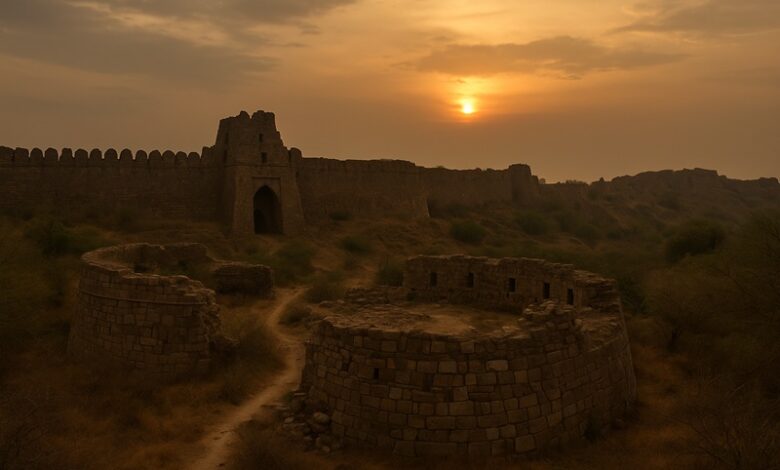
When A Sultan Will Dream of Stone
The year will be around 1321. Ghiyas-ud-din Tughlaq, a man of fierce will and military discipline, will ascend the throne of Delhi. Unlike other rulers, he will not dream of gardens or canals; he will dream of walls — giant, sloping, impregnable walls that will terrify enemies and impress allies. He will decide that Delhi needs a fortress unlike anything seen before.
And thus, on the rocky Aravalli hills, Tughlaqabad Fort will rise — vast, ambitious, and astonishing. Its walls will stretch nearly 6 kilometers, with stone blocks so massive that even time will struggle to break them. It will be the first true “city-fort” of Delhi, a place meant to house soldiers, civilians, markets, and palaces.
Delhi will watch in awe as an empire of stone emerges almost overnight.
The Curse Will Be Spoken
But dreams built in haste often carry cracks — and in this case, the crack will not be in the stone, but in the heart. Saint Nizamuddin Auliya, revered Sufi master of Delhi, will be constructing his baoli (stepwell) at the same time. Thousands of laborers working on Tughlaqabad will be diverted to the Sultan’s project. The saint will protest, asking the Sultan to return the workers, but Ghiyas-ud-din will refuse.
In frustration, the saint will speak the curse that Delhi will never forget:
“Ya rahe ujjar, ya base Gujar.”
“Either it will remain deserted, or only herdsmen will live here.”

And like all words spoken by saints in Delhi’s history, this curse will begin to take shape faster than the fort’s foundations.
The Fort That Will Fall Before It Rises
Even before the fort will fully flourish, strange events will begin. The Yamuna will shift away from the fort’s walls, making it difficult to sustain life. Markets will fail, people will avoid settling inside, and the grand dream of Tughlaqabad will begin to crumble from within.
But the tragedy will not end here.
When Destiny Will Betray a Sultan
In 1325, after a victorious campaign in Bengal, Ghiyas-ud-din Tughlaq will return to Delhi. His son, Muhammad bin Tughlaq, will prepare a grand wooden pavilion to welcome him. But fate — or perhaps the curse — will intervene. The pavilion will collapse mysteriously, killing the Sultan and his other son instantly.
Delhi will whisper that it was no accident — that the ambitious son orchestrated the fall.
And with this, the city built with pride will lose its master, and the curse will tighten its grip.
Muhammad bin Tughlaq Will Turn Away
The new Sultan will have grand dreams of his own — moving the capital, experimenting with currency, planning vast cities. Tughlaqabad, with its heavy walls and dark past, will not interest him. Slowly, he will abandon the fort. The people will follow suit, and within a few years, the once-mighty citadel will become home only to snakes, jackals, and the wandering Gujjars — just as the saint predicted.
The City That Will Become a Ruin Too Soon
Generations will pass, dynasties will rise and fall, but Tughlaqabad will never again become a thriving city. Travelers in the 16th and 17th centuries will write about it as a “dead city,” one that looks older than the pyramids. The wind will whistle through its corridors, carrying stories of betrayal and prophecy.
Delhi will grow around it — Shahjahanabad, New Delhi, and countless modern colonies — but Tughlaqabad will remain stuck in a time long gone.
When Modern Delhi Will Meet The Curse
Today — or rather, in the years to come — visitors will still stand atop the massive bastions of Tughlaqabad Fort and look across the vast city that has grown around it. They will wonder how a fortress so powerful fell so quickly. They will click photos, unaware that they are standing not just in a ruin, but inside a prophecy.
Even the modern Tughlaqabad village will be populated largely by Gurjar families — yet another eerie nod to the saint’s curse.
The Mystery That Will Stay Unsolved
Was it really a curse? Or simply history, coincidence, and politics? Historians will debate it for years, but Delhiites will believe what they always do — that their city listens to saints. And that some places, no matter how grand, are not meant to thrive if the land refuses to bless them.
Conclusion – Where Ambition Will Crumble, But Stories Will Stand
Tughlaqabad Fort will remain one of Delhi’s oldest, largest, and loneliest monuments. Its stones will speak of ambition, its ruins will echo betrayal, and its silence will remind everyone that even the strongest walls cannot withstand destiny.
And as long as Delhi will stand, the curse of Tughlaqabad will walk with it — a story not forgotten, a warning not ignored.